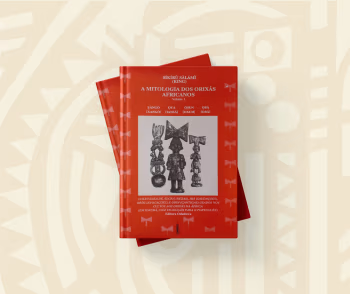
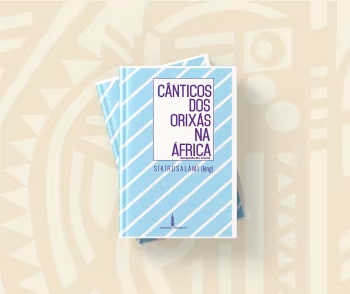
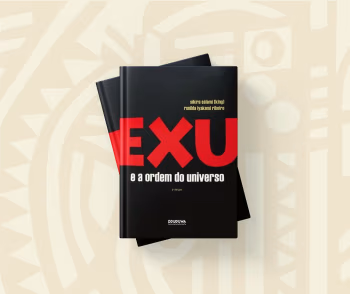
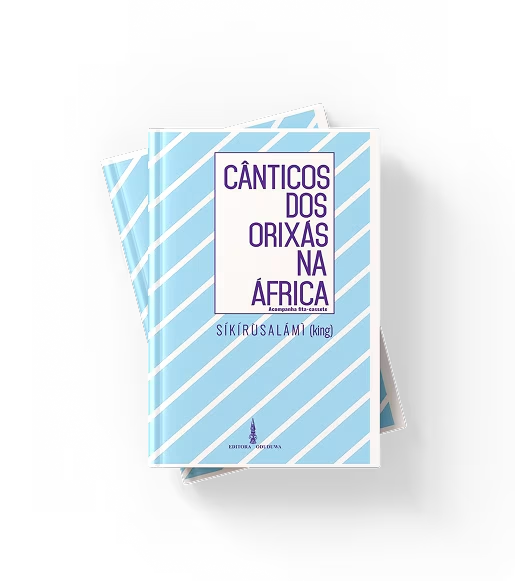
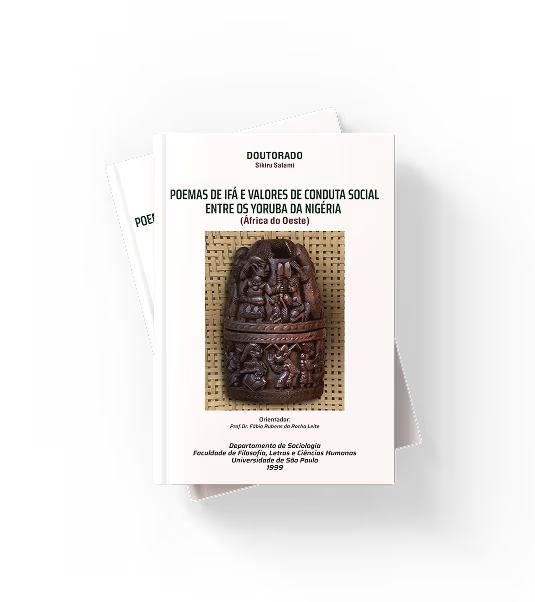
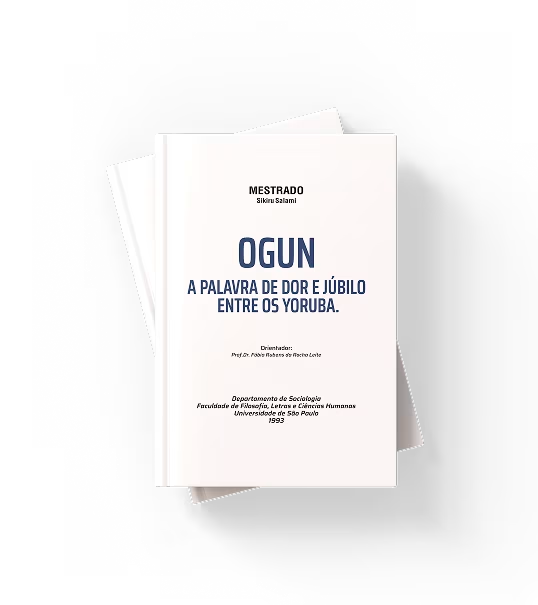
Oduduwa Publishing House was founded with the mission of recording, preserving, and sharing the vast intellectual and spiritual heritage of the Yoruba tradition and African cultures in Brazil. Through reference works written by Bàbá King and other scholars, such as A Mitologia dos Orixás Africanos [The Mythology of the African Orishas] (1990), Cânticos dos Orixás na África [Chants of the Òrìṣà in Africa] (1991), and Exu e a Ordem do Universo [Èṣù and the Order of the Universe] (2011), the publisher contributes to making oral traditional knowledge accessible to researchers, practitioners, and interested individuals worldwide. Each publication is the result of a commitment to historical accuracy, the appreciation of the Yoruba language, and the strengthening of African roots.
Works that record and share the spiritual foundations of the Yoruba tradition.
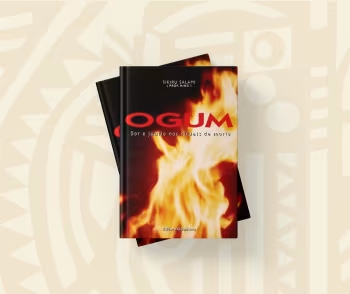
In this book, I intend to present part of my personal experience in the worship of these deities. It also presents data obtained...
Check out further information
This work, written by this young African man in his early thirties, is the òrìṣà’s response – at the end of this 20th century...
Check out further information
Èṣù. Is he benevolent or malevolent? Is he the Yoruba equivalent of Satan and the devil of the Judeo-Christian and Islamic traditions?
Check out further information
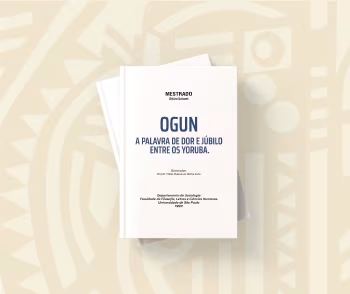
Deep connections were established between Africa and the Americas during the long period of slavery.
Check out further information
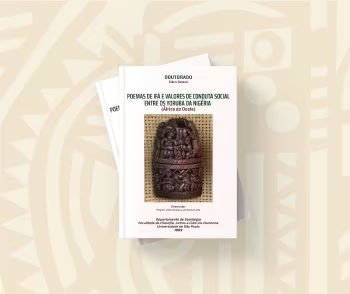
This study aims to demonstrate that certain oral statements from the Ifá Literary Corpus...
Check out further information
Deep connections were established between Africa and the Americas during the long period of slavery.
Check out further information
In this book, I intend to present part of my personal experience in the worship of these deities. It also presents data obtained...
Check out further information
This work, written by this young African man in his early thirties, is the òrìṣà’s response – at the end of this 20th century...
Check out further information
Èṣù. Is he benevolent or malevolent? Is he the Yoruba equivalent of Satan and the devil of the Judeo-Christian and Islamic traditions?
Check out further information
Deep connections were established between Africa and the Americas during the long period of slavery.
Check out further information
This study aims to demonstrate that certain oral statements from the Ifá Literary Corpus...
Check out further information
Deep connections were established between Africa and the Americas during the long period of slavery.
Check out further informationLearn wherever you are by exploring our online courses and expanding your knowledge of the orishas
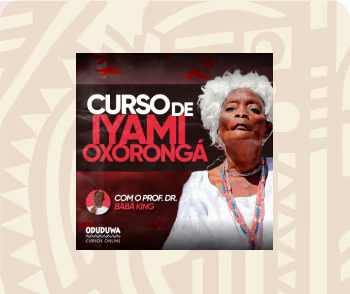
Who are the powerful Ìyámi Òṣòròngà, and how to understand their strength and supremacy in relation to magic, good, and evil.
Further information about Ìyámi Òṣòròngà
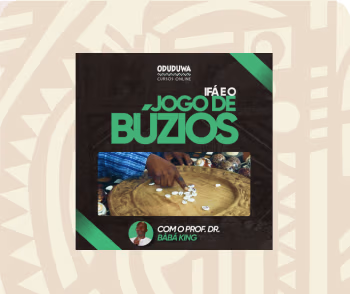
Learn how to practice the divination in the correct sequence and how the secondary odù supplement the main odù. Understand the relationship between them through practical examples.
Further information about the practice of the divination
Learn how to worship your Orí through actions, songs, and prayers. Learn about the elements offered to the Orí and their meanings.
Further information about the Orí
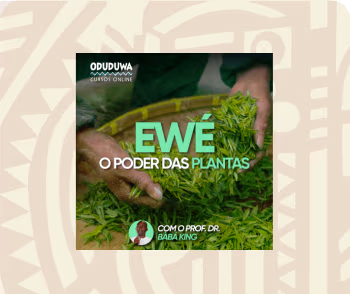
Learn the theory and practice of working with plants and extracting the maximum of their àṣẹ, from harvesting to handling, just as practiced by wise people in Africa for millennia.
For further information about Òsányìn and about the power of plants.
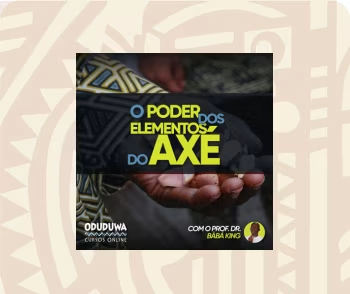
Understand the active principles present in elements such as water, fire, earth, air, kola nuts, bitter kola, palm oil, shea butter, among others, from plants, mineral, and animal kingdoms. And how to apply them to maximize the extraction of their àṣẹ and its results.
For further information about àṣẹ elements
Discover the òrìṣà of youth and over 20 Ẹgbẹ́ qualities and their functions, a topic explored for the first time outside Africa!
For further information about Abíkú and Ẹgbẹ́
Learn about this important deity through her mythology, symbols, food, and leaves. Also learn about Ọ̀ṣun's qualities, names given in her honor, and her relationship with the abíkú.
For further information about Ọ̀ṣun
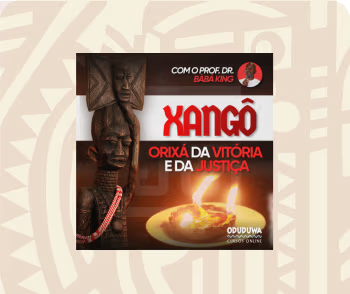
Learn fundamental concepts about the worship of Ṣàngó, including offerings, symbols, meanings, and ways to obtain the àṣẹ of victory, justice, defense, and prosperity in life.
For further information about Ṣàngó
Learn songs, prayers, and how to invoke Ajé to attract abundance into one's life in Yoruba, the sacred language of the òrìṣà, with translation into Portuguese.
For further information about Ajé
Learn salutations, chants, and prayers to invoke Olójó in Yoruba, the sacred language of the òrìṣà, with translation into Portuguese.
For further information about Olójó
When we talk about anatomy, we immediately think of the physical body. But there is also spiritual anatomy, which is just as responsible for human survival as one's physical constitution.
For further information about spiritual anatomy
Who are the powerful Ìyámi Òṣòròngà, and how to understand their strength and supremacy in relation to magic, good, and evil.
Further information about Ìyámi Òṣòròngà
Learn how to practice the divination in the correct sequence and how the secondary odù supplement the main odù. Understand the relationship between them through practical examples.
Further information about the practice of the divination
Learn how to worship your Orí through actions, songs, and prayers. Learn about the elements offered to the Orí and their meanings.
Further information about the Orí
Learn the theory and practice of working with plants and extracting the maximum of their àṣẹ, from harvesting to handling, just as practiced by wise people in Africa for millennia.
For further information about Òsányìn and about the power of plants.
Understand the active principles present in elements such as water, fire, earth, air, kola nuts, bitter kola, palm oil, shea butter, among others, from plants, mineral, and animal kingdoms. And how to apply them to maximize the extraction of their àṣẹ and its results.
For further information about àṣẹ elements
Discover the òrìṣà of youth and over 20 Ẹgbẹ́ qualities and their functions, a topic explored for the first time outside Africa!
For further information about Abíkú and Ẹgbẹ́
Learn about this important deity through her mythology, symbols, food, and leaves. Also learn about Ọ̀ṣun's qualities, names given in her honor, and her relationship with the abíkú.
For further information about Ọ̀ṣun
Learn fundamental concepts about the worship of Ṣàngó, including offerings, symbols, meanings, and ways to obtain the àṣẹ of victory, justice, defense, and prosperity in life.
For further information about Ṣàngó
Learn songs, prayers, and how to invoke Ajé to attract abundance into one's life in Yoruba, the sacred language of the òrìṣà, with translation into Portuguese.
For further information about Ajé
Learn salutations, chants, and prayers to invoke Olójó in Yoruba, the sacred language of the òrìṣà, with translation into Portuguese.
For further information about Olójó
When we talk about anatomy, we immediately think of the physical body. But there is also spiritual anatomy, which is just as responsible for human survival as one's physical constitution.
For further information about spiritual anatomySee the upcoming confirmed courses taught by Prof. Dr. Bàbá King.
Courses taught by Prof. Dr. Bàbá King about Ifá Ọ̀rúnmìlà, the Òrìṣà, spirituality, and traditional knowledge.

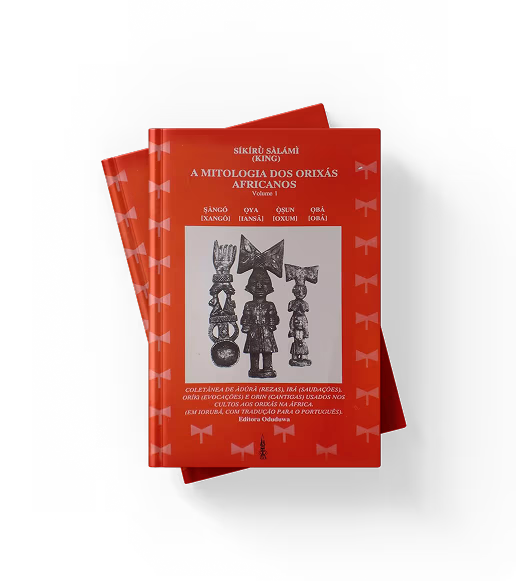
In this book, I intend to present part of my personal experience in the worship of these deities. It also presents data obtained from extensive research conducted in Nigeria with bàbáláwo, bàbálọ́rìṣà, and ìyálọ́rìṣà — notable and respectable individuals known for their knowledge and full dedication to sacred services. Over the last five years (1985-1990), I took several trips to record significant data on the worship of the òrìṣà. The ìbà oríkì, adúrà, and orin presented here are in authentic and traditional Yoruba, precisely as they are used in the worship of the òrìṣà in Nigeria. These oral poetry pieces are filled with metaphors and symbols. Their language is difficult to interpret and a true challenge for the translator to render in a way understandable to Portuguese speakers. Through the poetic pieces presented here, we can perceive the weight of the oral transmission of Yoruba knowledge. Some words and expressions referring to particular òrìṣà repeat in nearly all references made to them wherever they are worshipped. These words are key to understanding the òrìṣà and to comprehending the legends that surround them, even when these accounts may sometimes seem contradictory.
Ire o!
The author. São Paulo, June 1991.

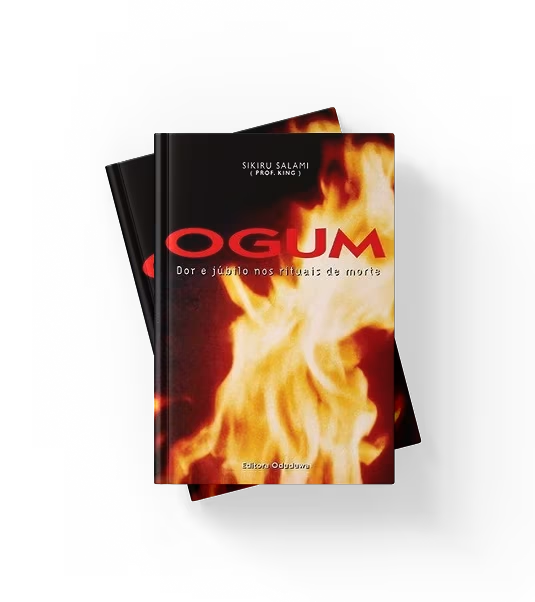
Deep connections were established between Africa and the Americas during the long period of slavery. The great symbolic wealth carried by Black people is crucial to the cultural amalgamation of diaspora countries. In this work, the author records oral statements, ìrèmọ̀jé and ìjálá, songs of sorrow and joy sung to Ògún, the Great Òrìṣà, the civilizing hero. Through the songs presented here, Ẹgbẹ́ Ọdẹ́, the society of hunters, blacksmiths, miners, and other professionals whose activities involve working with metals, reveals itself. Through these songs, Ògún, Ògún àwa yè, in whose strength we are strong, reveals itself. This work, the result of many years of effort and dedication, is welcomed by many. Devotees of the Òrìṣà, intellectuals, and artists, those awakened and semi-awakened to the importance of breaking the silence will benefit from it. The children of Ògún will surely turn to the waters of this spring, happy to now possess, in the Portuguese language, reliable information about this great òrìṣà from his territory of origin.
Ògún àwa yè! Àwa yè! Our Ògún is life! We are strong!
Ronilda Iyakemi Ribeiro. Coordinator of the Study Group on African Ancestry and Citizenship - GEAAC, PROLAM/USP

This work, written by this young African man in his early thirties, is the òrìṣà’s response – at the end of this 20th century, a time of so much physical revolution – to a suffering people, descendants of the Yoruba tradition, initially established in Bahia and later spread throughout Brazil. Current times bring news to the òrìṣà people: the possibility of expression, the certainty that religious and cultural tradition must be maintained. Therefore, a young Nigerian man from Abẹ́òkúta, inspired by the Odù that governs the 20th century, has the idea of publishing a series of informational books as a reward to those who arrived in the West without knowing how or why. Adopting an educational approach adapted to current times, no human being can, in the worship of the òrìṣà, disregard the written form. By translating the orin and oríkì of the òrìṣà, he provides everyone with the wisdom of what is sung, thus bringing Son and Father closer to one another. Nothing is more gratifying than knowing the meaning of what we are singing.
Àṣé Ọkanléńigba ìmalẹ̀ yóò bá ọ gbé làyè.
The àṣẹ of the two hundred and one deities will accompany you throughout your life.
Maria Stella de Azevedo Santos.
Ọdẹ Kayọde. Salvador, Bahia, October 1991.
Ile Aṣẹ Opo Afọnja.

Èṣù. Is he benevolent or malevolent? Is he the Yoruba equivalent of Satan and the devil of the Judeo-Christian and Islamic traditions? Is he the Yoruba equivalent of Priapus, the Greco-Roman phallic god, guardian of houses, squares, streets, crossroads, gardens, and orchards? Considering the already traditional controversy regarding the nature of this òrìṣà, one of the main goals of this work is to contribute to re-signifying him by explaining his place within Yoruba theology, given that a distorted image of his nature and duties has been perpetuated in many countries of the Yoruba diaspora. Pursuing the said goal, our point of departure is the corpus of Yoruba tradition to avoid interpretations outside that context. The book contains three parts: Part I - The Yoruba: human, divine, and ethical-moral code; Part II – Èṣù Theological and liturgical aspects; Part III - The Presence of Èṣù in the Corpus of Yoruba Oral Tradition. It includes a Glossary. We hope this work contributes to dispelling negative stereotypes about the orisha Èṣù, to offer a better understanding of the religious social practices of Yoruba origin developed in diaspora countries, and to prompt reflections on African theologies and African-based theologies. Àṣẹ!
Láaróyè! The Authors.

This study aims to demonstrate that certain oral statements from the Ifá Literary Corpus, the oracular system of Yoruba society, have historically contributed to shaping social conduct values. From the perspective adopted here, these statements transcend their literary configuration – which is, indeed, substantial – to achieve the status of a system endowed with historical dynamics. The goals of this work also include (1) participating in the collective project of several researchers to record and disseminate the Ifá Literary Corpus; (2) furthering the task of elucidating differential aspects of the Yoruba contribution to the body of knowledge about Black-African orality; and (3) contributing to a perhaps more appropriate understanding of the Black-African heritage internalized in Brazilian society. The study addresses aspects of Yoruba society, including notions of vital force (àṣẹ) and personhood, as well as the capacity for achievement (related to Orí) and the ability to dynamize actions involving nature and society (ẹbọ). The author also examines elements pertaining to the configuration of the oracular system through the transcription of 30 (thirty) Ifá poems (odù) in Yoruba and Portuguese, linked to the issue of social conduct, obtained in field study conducted in Nigeria, and analyzed by the narrators themselves and then by the author. The author points out that the analyzed odù constitute part of a much broader literary corpus that also addresses other themes. The work is mainly based on the original Yoruba word through the notable figure – bàbáláwo – who transmitted to the researcher part of their knowledge, stemming from their deep understanding of this ancient system for penetrating reality.
The Author

Deep connections were established between Africa and the Americas during the long period of slavery. The great symbolic wealth carried by Black people became crucial to the cultural amalgamation of diaspora countries.
This work records oral statements, ìrèmọ̀jé and ìjálá, songs of sorrow and joy sung to Ògún, the Great Òrìṣà, the civilizing hero. Through the songs presented here, Ẹgbẹ́ Ọdẹ́, the society of hunters, blacksmiths, miners, and other professionals whose activities involve working with metals, revealed itself. These songs reveal Ògún, Ògún àwa yè, in whose strength we are strong.
This work, the result of many years of effort and dedication, is welcomed by many. Devotees of the Òrìṣà, intellectuals and artists, those awakened and semi-awakened to the importance of breaking the silence will benefit from it. The children of Ògún will surely turn to the waters of this spring, happy to now possess, in the Portuguese language, reliable information about this great òrìṣà from his territory of origin.